


Dramble: moving the control plane off a Pi
The little cluster had been up for five days and the API was disappearing every
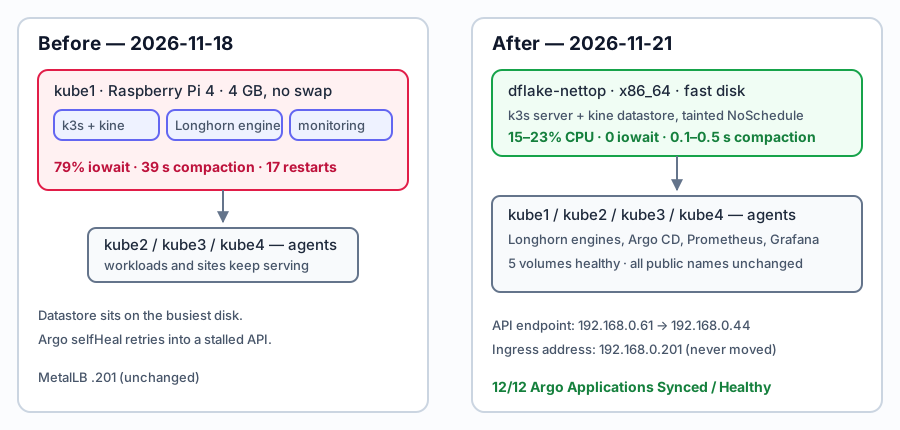
ten to twenty minutes. By the evening of 2026-11-18, kube1 had restarted k3s
17 times — 16 of them that day. Pods kept serving, sites stayed up, and
then kubectl would simply stop answering for a minute. That is a very
specific kind of uncomfortable.
This is the story of moving the control plane to a different machine, and of the second, unrelated problem that only showed up after the move.
First, read the evidence
The obvious suspect was Argo CD. I had just put twelve Applications on automatic sync with self-heal, and every time the API stalled they all retried against a server that could not answer. More load begets more load, so I denied automated sync on both AppProjects and gave myself a breathing window.
That was the right first move, but it was not the cause. The logs said:
Slow SQL: DELETE ... name=Compact   duration=39.27s
level=fatal  msg="Transaction commit failed: sql: transaction has already been committed or rolled back"
k3s uses kine — SQLite translated into an etcd-shaped API — in process, on
the server node. kube1 is a 4 GB Raspberry Pi with no swap, and it was running
the datastore, the Longhorn engine, and the monitoring stack on one disk.
Measured at the time: 79% iowait, load 20–27 sustained, and both
longhorn-manager and argocd-application-controller stuck in D state
(uninterruptible I/O sleep). Argo’s controller was using about 1.6% of a core.
It was a bystander.
So the fix was not to tune SQLite, and definitely not to delete Argo. The fix was to get the datastore off the contended disk.
The move, in one careful sequence
There is deliberately no off-cluster Longhorn backup in this cluster. Five
volumes hold the sites and monitoring history, and the Volume, Snapshot and
Backup objects that describe them live inside that SQLite file. A
control-plane migration is therefore a datastore migration: the highest-risk
operation I can perform here.
- Stop k3s on
kube1so the write-ahead log was quiesced, then archive/var/lib/rancher/k3s/server— the database, the CA, the certs and the join token. Keep an untouched copy on the old node. - Install k3s on
dflake-nettop, an always-on x86_64 box on the same LAN with a fast disk. Crucially: taintedNoSchedule, and installed withSKIP_START/SKIP_ENABLEso it could not initialise an empty cluster before I restored the real one. - Restore the archive, delete the old apiserver certificate so it gets
reissued for the new address, and start it.
/readyzreturnedok; all five Longhorn volumes came back attached and healthy. - Disable the server unit on
kube1, retire its state directory, and rejoin all four Pis as agents pointing at the new API. Then repoint the admin kubeconfig — the CA survived, so only the URL changed.
One thing that did not change: 192.168.0.201. That is a MetalLB address
announced by the Pis for Traefik, not the API endpoint. Nothing in DNS or on the
router needed touching, and the public sites never moved. Only
192.168.0.61:6443 → 192.168.0.44:6443.
Then nettop’s CPU hit 99%
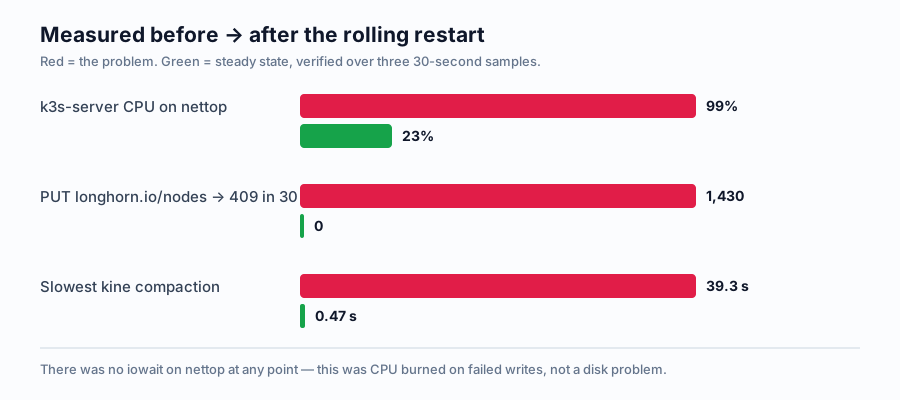
Five minutes after the cutover, the new server was pinned to two cores. This looked exactly like the old failure repeating itself, which is a good way to make a bad decision quickly.
I checked the easy things first. iowait over six seconds: zero. Kine
compactions: 104–467 milliseconds, against 39.27 seconds on the Pi. No
fatal lines, no slow-SQL warnings. It was not the datastore.
The API server’s own request counters gave it away:
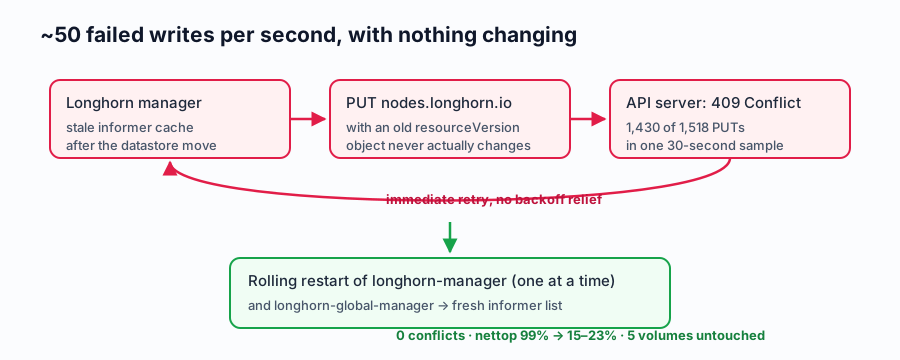
1518  PUT  longhorn.io/nodes   in 30 s
1430  of them returned 409 Conflict
And the object’s resourceVersion did not move. A stale informer cache in the
Longhorn controllers — left over from the datastore swap — was writing an old
resource version, getting rejected, and retrying immediately. Roughly fifty
failed writes a second, with none of them changing anything. 94% of those
writes were conflicts.
This is where I nearly reached for the bigger hammer. Would etcd be better than SQLite? For this failure, no: a single-node etcd adds raft, fsyncs and its own compaction on top of the same fifty writes a second. It would make the loop more expensive, not less. The datastore was never the problem.
The fix was a rolling restart of longhorn-manager — one pod at a time, waiting
for each to come back — and longhorn-global-manager. Fresh informer lists,
fresh resource versions. Conflicts went to zero, CPU dropped to 15–23%,
and all five volumes stayed healthy throughout.
Turning Argo back on
With the API steady and the loop gone, the emergency holds had served their
purpose and were actively in the way: longhorn had been registered as an
Application but had never synced, so it sat OutOfSync behind the deny window.
I synced it manually while the hold was still in place, watched the metrics for
four minutes (zero 409s, about 80 writes in 30 seconds total), then cleared the
window on the default AppProject and watched again. Both holds came off once
I had evidence that nothing came back.
The steady-state cost of Argo here is almost funny: the application controller uses 11 millicores and 264 MiB, and writes to Applications about three times every thirty seconds. The Longhorn loop it had been blamed for was fifty writes per second. There is no reason to rethink Argo CD on this cluster — the two incidents were a slow Pi disk and a stale storage controller cache.
All twelve Applications are now Synced / Healthy, with self-heal restored.
What I take from it
- A hold is not a fix. It buys time to measure. If you leave it in place, drift quietly accumulates behind it.
- Measure before choosing the datastore. iowait, compaction timings and the API’s own request counters separated “disk is slow” from “controller is looping” in minutes.
- A 409 is a signal, not noise. A high conflict rate means something is retrying against state it no longer agrees with. Restarting the controller is cheaper than rebuilding the cluster.
- Keep the control plane boring. The new server is tainted, so even Argo stays on the Pis. Nothing competes with the database for that disk.
The full operator runbook, including the exact commands and the rollback
details, is in
docs/control-plane-migration-nettop.md.
The measured failure evidence and the follow-up items are in
docs/action-items.md.
How this was written
A large part of this work was produced with AI assistance. The agent used was
MiMo-V2.6-Flash (model ID mimo-v2.6-flash), running in OpenCode, and it
did the bulk of the implementation: analysing the logs, writing the migration
runbook, driving the verification commands, updating the repository docs and
drafting this post.
I read and verified all of it myself before publishing. Every claim here — the restart counts, the 39.27-second compaction, the 1,430 conflicts, the CPU figures, the volume health and the final Application states — was checked against the cluster, the logs or the repository rather than taken on trust. The decision to reject etcd, and the choice to restart the Longhorn controllers instead, were mine after reading the measurements.
The three diagrams in this post were drawn for it and contain no third-party
artwork; see assets/images/CREDITS.md.